
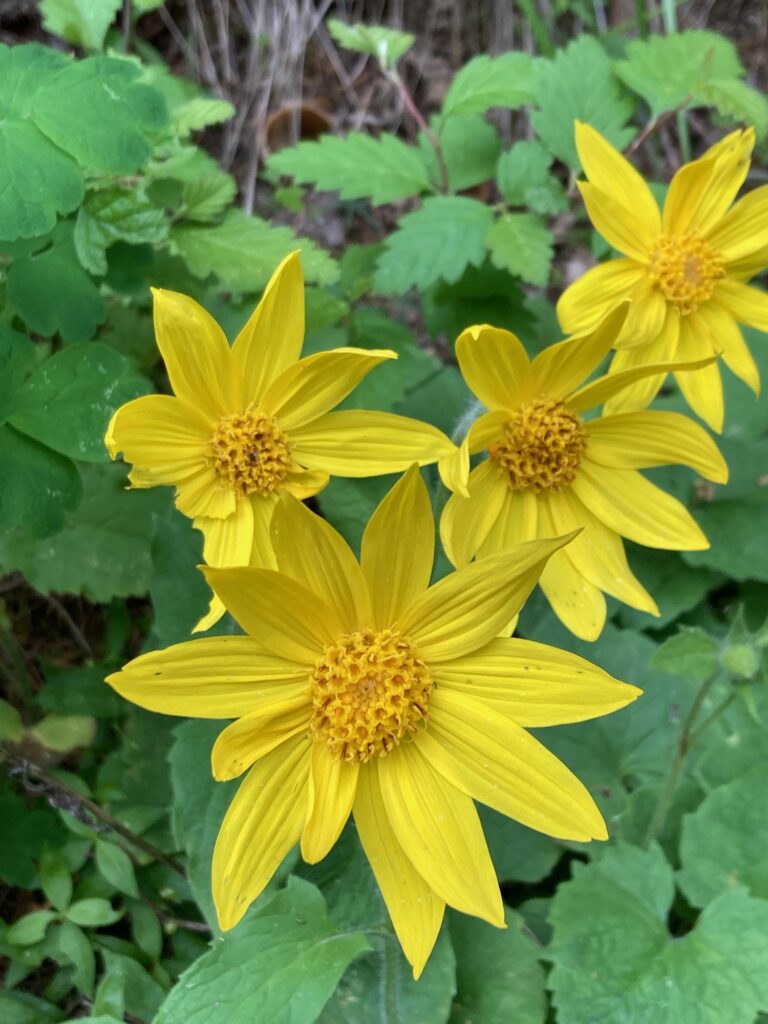
Arnica is the first true gold the forest gives. It opens while the pine-shade is still cold and the ground still holds the memory of snow — small suns on tall stems, lifted over a low nest of heart-shaped leaves. It is a mountain plant and a wild one, kin to the sunflower and, like it, a keeper of the sun’s own color. The people who have known it longest called it a wolf’s flower, and they were not speaking idly.

Where it grows, and how it shows up here

Arnica cordifolia — arnica of the heart-leaf. The name arnica is worn down from an old word for lamb, for the soft down over leaf and stem; cordifolia is plainer still: heart-leaf. The leaves are the surest way to know it — facing pairs, heart-shaped, coarsely toothed, soft under the thumb. Few of its kin in the daisy family carry their leaves paired that way; the wolf’s flower does. Above them the flower opens, eight to fifteen rays of pointed gold around a golden center. The heart-leaf tells it from its narrower-leaved cousin, the broadleaf arnica; both are true arnica, and where they meet they mingle.
Here it keeps to the pine shade. It comes up along the green banks at the feet of the ponderosas, threaded through the lupine and the spring grass, in dappled light under the trees rather than out in the open. It is no scattered, shy plant on these grounds — it runs in strong stands beneath the conifers, spreading below the ground so that a single stand is often one plant wearing many faces, and it gilds the forest floor where it takes hold.

When it comes
Arnica belongs to the early year. It wakes in the spring shade while the ground is still cold, lifts its stems, and comes to full gold by the middle of May — one of the first flowers the forest offers, well ahead of the midsummer bloomers. The gold does not linger long. When the flowering is spent it looses its seed on the wind and draws back down into the root to wait out the rest of the year. Here it is a plant of the spring shade, not of high summer; some years the gold comes a little later, but always early. The forest keeps arnica’s calendar.

The wolf in the flower

Arnica came into the old stories as a wolf’s flower — Wolfsblume in the German tongue, and Wolfsbanner, wolf-banner, and Donnerwurz, thunder-root, and Fallkraut, the fall-herb, and Johannisblume, the flower of St. John.
Its oldest story is the story of the corn-wolf. In the grain countries it was told that a wolf-spirit — the Kornwolf, the rye-wolf, one of the field-spirits that moved through the standing grain — carried the strength of the harvest in it as it went. Arnica was set at the edges of the field to keep the wolf inside, so its strength would not leave before the grain was ready; and when the last stand of grain was cut, the wolf was said to pass into the final sheaf, which was carried home and honored. At the year’s turning, on the eve of St. John’s, bunches of arnica stood at the four corners of the fields to hold the grain safe through midsummer — and the flowers gathered on that longest-lit day were held the strongest of the whole year.
Sun, fire, and the living ward

Arnica answers to the Sun and to the element of Fire — a solstice flower the color of caught daylight, and every part of its magic runs back to that. Its first and deepest office is protection.
That protection has a particular shape: a living boundary. Arnica set around a place was said to pen a spirit within it, or hold an unfriendly one out — but only for as long as the plant lived; when it died back into the ground in the fall, the ward went with it. This is the corn-wolf custom read as magic: a circle of living gold that keeps what it guards only while it is green. To ring a field, a garden, or a threshold with arnica is to raise a wall that must be kept alive to keep standing.
Its wolf-names carry the same charge from the other side. Called wolf-banner and, more bluntly, wolf-murderer, arnica was counted a bane to the wolf-spirits — and those same spirits were held to ride the thunderstorms. So it became a plant of weather-magic: burned to turn a storm aside, hung in the house or grown in the garden to guard against lightning, with a small charm spoken over the burning to bid the arnica catch and the storm take flight.
Past the ward, arnica carries the sun’s own virtues — strength, courage, and vitality, kept in a sachet for steady nerve, laid on the altar as an offering to the sun and the powers of the longest day. Its clear, bright nature lends it also to clear-sight and intuition, the seeing-through a sun-plant grants. In the working it is met as dried flowers: burned on the coal for protective, clear-seeing smoke; set at doors and field-corners; stuffed into guarding poppets; steeped into a floor-wash or a well-strained ritual bath (never taken in, kept from the eyes and from broken skin). It keeps good company with rosemary and rue for warding, and a bay leaf for courage at the threshold.
Its nature and virtue
Arnica is the fall-herb — the plant turned to after a fall, a knock, a wrenched and aching step. In its old office it met the body exactly where the body had been struck: the bruise, the sprain, the shock of a hard landing, worked into oil or salve and laid on the skin. Read at the level of spirit, this is its truest work — arnica goes to the place of injury and calls the self back to a body that has been hurt, or startled out of itself. It mends the seam between the two.
And it keeps a wolf’s rule: worked from without, never taken within. That is its nature and its boundary both, and it is not a plant that suffers the boundary crossed. Its affinities are the mountain and the wolf, the midsummer sun and the color gold, the threshold and the edge, the moment of hurt and the turn toward mending. Its bright face is a plain comfort, too — the sun’s own flower has always been good at lifting a heavy heart.
In the stillroom
Arnica is one of the first flowers I gather each year, while the mornings are still cold and the gold is new in the pine-shade. I keep a few old rules at the stands: flowers only, never the roots; never more than a third of any stand in a season; and a picture of the living stand before I take a single bloom. The stands here are strong, and the rules are how they stay that way.
The flowers wilt a few hours on the screen, then go into good olive oil to steep low and slow. When it’s ready I pour off the clear oil and leave the settled cloud at the bottom behind. That oil becomes the Arnica Salve — arnica in oil and beeswax, and nothing it doesn’t need — and the Trauma Blend, where arnica meets yarrow and plantain, three plants of the grounds in a single tin. Both are for the skin, and never for broken skin.

