
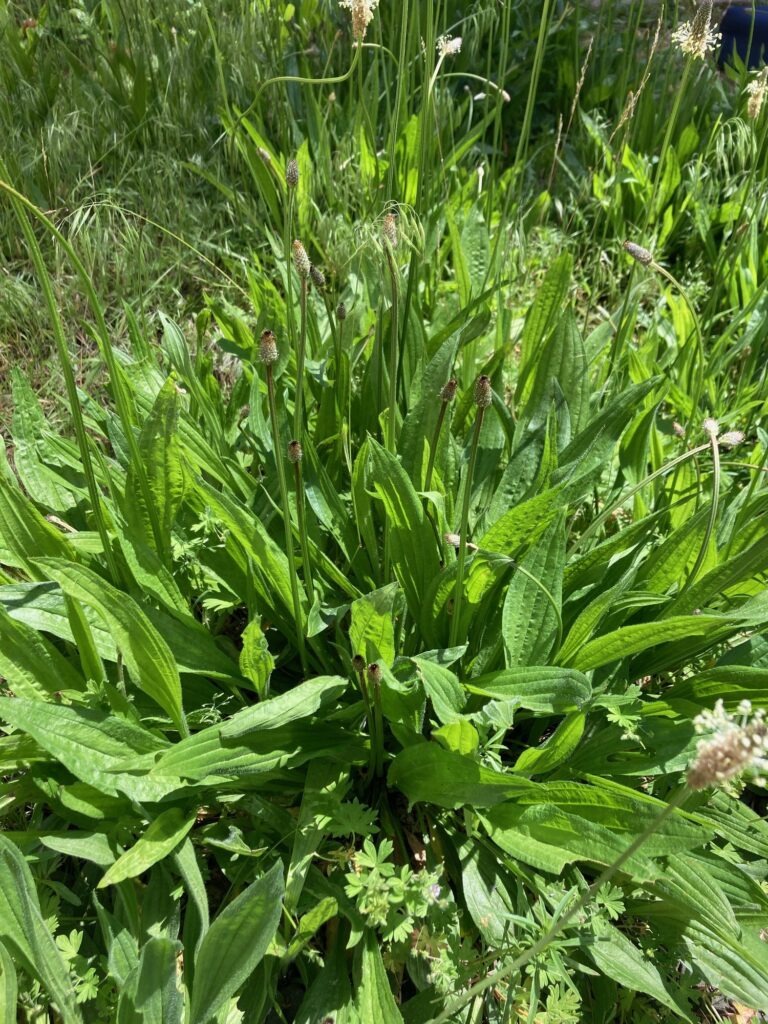
The mother of herbs, underfoot
There is a plant so common that most people have never once seen it. It grows in the lawn and the driveway and the crack in the path, flat to the ground and trodden daily, the first green to take a bare patch and the last to be driven out of it. It asks for nothing and it is walked on without a thought. And yet the oldest herb-charm in the English tongue does not call it a weed. It calls it the mother of herbs — and sets it, by name, against poison and against the thing that fares through the land in the dark.

Where it grows, and how it shows up here

Plantago lanceolata — plantain of the little lance, for the leaf. The whole family carries an older name still: Plantago, from planta, the sole of the foot — the flat leaf pressed to the earth like a footprint, and the herb that keeps to the places feet have pressed. The narrowleaf is the surest to know by its leaves: long and slender and lance-shaped, standing up in a loose rosette, and ribbed the whole length with strong parallel veins that stand proud on the underside — draw a leaf between two fingers and you feel the cords of them. Those ribs are its plainer name, ribwort, and once felt they are never mistaken. Above them the flower rises on a long, grooved, wiry stalk: a short dark cone, and around its base a halo of tiny white stamens on fine threads, a pale ring that climbs the cone as it opens. The stalks are tough enough that children have long fought them head against head — the old game of soldiers, of kemps.

Here it keeps to the open grass — the sunlit, well-trodden ground along the paths and the mown edges, in the light rather than the tree-shade, where it comes up in strong stands that spread below the ground so a single patch is one plant wearing many crowns. And it does not grow here alone. Its broad-leaved kin, Plantago major — greater plantain, the cart-track plant, the one the old Native names called white man’s foot for the way it sprang up wherever the settlers walked — holds the harder ground down along the driveway, flat rosettes of broad oval leaves in the compacted gravel, sending up long slender green rat-tails of seed. The keeper knows them apart at a glance and keeps them apart in the gathering: the narrowleaf is taken from the clean open grass; the broadleaf is left to the drive and the ground the wheels pass over. Two sisters of one house — one gathered, one greeted and let be.

When it comes
Plantain is ever present, surviving even under deep snow. Where arnica is a fortnight of May gold and St. John’s Wort a few weeks around the solstice, plantain is up early and stays late — in leaf while the ground is barely warm, gatherable here from the first warm weeks of the year, sending up its cones toward midsummer, and holding on through the heat with fresh green leaf and new flower-stalks long after the brief bloomers have gone to seed and quit. It is the constant of the green season, not its festival: a plant you can walk out to on almost any day and find.

Waybread, and the mother of herbs
No plant has been given more names by more people, and every name is a memory of what it did. The Anglo-Saxons called it wegbrade — waybread, the bread of the way — for the herb that lines every path and road, and the tongues after them kept it: waybroad, ripplegrass, cuckoo’s bread. Others named it for its work on the body: healing blade, soldier’s herb, the wound-leaf reached for on the march. Still others named it snakeweed and snakeroot, for the belief that it drew the venom from a bite. And across the sea it earned the name that troubled those who gave it — white man’s foot, Englishman’s foot — the plant that appeared in the footprints of the newcomers and followed them wherever they went.
Its oldest and greatest telling is in the Nine Herbs Charm, set down by Anglo-Saxon hands in the tenth century and older than the page it rests on — a healing-charm of nine sacred worts, and plantain among the first of them, hailed not as a weed but as the mother of herbs:
And you, Waybread, mother of herbs, open from the east, mighty within. Over you carts creaked, over you queens rode, over you brides cried out, over you bulls snorted. All this you withstood, and dashed apart — so you withstand poison, and the loathly one that fares through the land.
That is the whole of plantain’s character in a breath. It is the plant that is trodden by everything — cart and queen and beast — and endures it, and rises again; and because it withstands the weight of the world, it was held to withstand venom and evil as well. The herb underfoot that will not die became the herb that guards against the things that would lay you low.
Venus, earth, and the drawing of the thorn
For all that it walked to war with soldiers, plantain answers to gentle Venus, and to the element of Earth — a feminine, grounding, earth-fast plant, close to the soil it lies flat against. Culpeper set it plainly under Venus, and the herb-magic that came after kept it there: the low green healer, the steadying one.
Its offices run from that nature. First is the drawing-out — plantain is the herb that draws to the surface and lifts away what should not be lodged within: the splinter and the thorn, the sting and the grit, and in the old belief the venom of the bite. Where yarrow closes a wound and holds its edges, plantain does the opposite and necessary thing — it opens, draws, and empties. Close beside it stands strength and endurance, the gift of the trodden survivor: dried and carried, or bound to the body with red wool, for the steadiness of a thing that is walked on and comes back. Then protection, and of a particular road-bound kind — this is the traveler’s herb, the waybread, laid in the shoe or carried in the pocket against the hidden dangers of the journey, hung in the house and (in the newer tellings) the car to guard the coming and going, worn as the old amulet against snake and sting on open ground. And last, its mother-of-herbs office: plantain is the herb that lends its strength to a working, deepening whatever it joins — never the whole charm on its own, always the one that makes the rest hold.
In the working it is met as the leaf and the dried flowering stalk: bruised and drawn upon for the splinter and the sting; bound into the protective and strengthening sachet; tucked in the shoe for safe travel; carried against venom; added to a charm to steady and deepen it. It keeps the company of the other Nine, and of the wound-herbs it works beside — yarrow the stauncher, self-heal the mender — the drawer among the closers.
Its nature and virtue
Plantain is the drawer and the endurer, and its two virtues are one virtue seen from two sides. It draws out — the thorn, the sting, the buried and festering thing, the small poison worked under the skin — and it endures — the tread of the whole world, and rises green from the print of the boot. Read at the level of spirit, this is a plant for the thing lodged where it should not be and the strength to outlast the weight that would flatten you: it lifts out the splinter of the heart as readily as the hand, and it is a plain, low, unkillable comfort for anyone who has been walked on and means to come up green again. It asks so little and gives so steadily that it is easy to overlook — which is, in the end, the whole of its lesson.
It is a plant of the path and the dooryard, and it has always been a plant of the table as much as the charm: waybread is a bread-name, and the young leaves have fed travelers and foragers for as long as they have mended them — the humble green that grows where people are and asks to be used. It is the gentlest of the Keep’s gathered plants, with none of the wolf’s rule that keeps arnica to the unbroken skin; where a caution belongs, it belongs to the fiercer company it sometimes keeps, not to plantain, which has spent its whole long history being kind. Its affinities are the footpath and the threshold, the sole of the foot and the ground it presses, the color green and the number of the sacred Nine, the drawing-out and the coming-back. Its companions are the mending herbs and the guardians of the road.
In the stillroom


Plantain is the plant I gather most and worry over least. I take the narrowleaf ribwort from the open grass — never the broadleaf down along the drive, which I leave to the driveway and the wheels that pass over it — the clean leaf from the clean ground, and there is always more than I could ever use. I cut leaf and flowering-stalk both, never more than a third of any stand, and take a picture of the living patch before I lift a leaf, the same old rule I keep at every stand.
The leaves wilt a few hours on the screen, then go into good olive oil to steep low and slow until the oil runs deep green — the color of the drawn-out virtue held in the jar. That green oil is the quiet backbone of the stillroom. Plantain meets arnica and yarrow in the Recovery Rub — three plants of the grounds in a single tin, the drawer beside the mender and the stauncher — and it goes into the Bite Balm beside yarrow, pineapple weed, and self-heal, the soothe-after leaf in a summer tin. It is never the whole of a blend and always the ground of it, the mother-herb doing underneath what the others do on top. Both blends are for the skin, and (for the arnica they carry) never for broken skin.
