
The mender in the grass
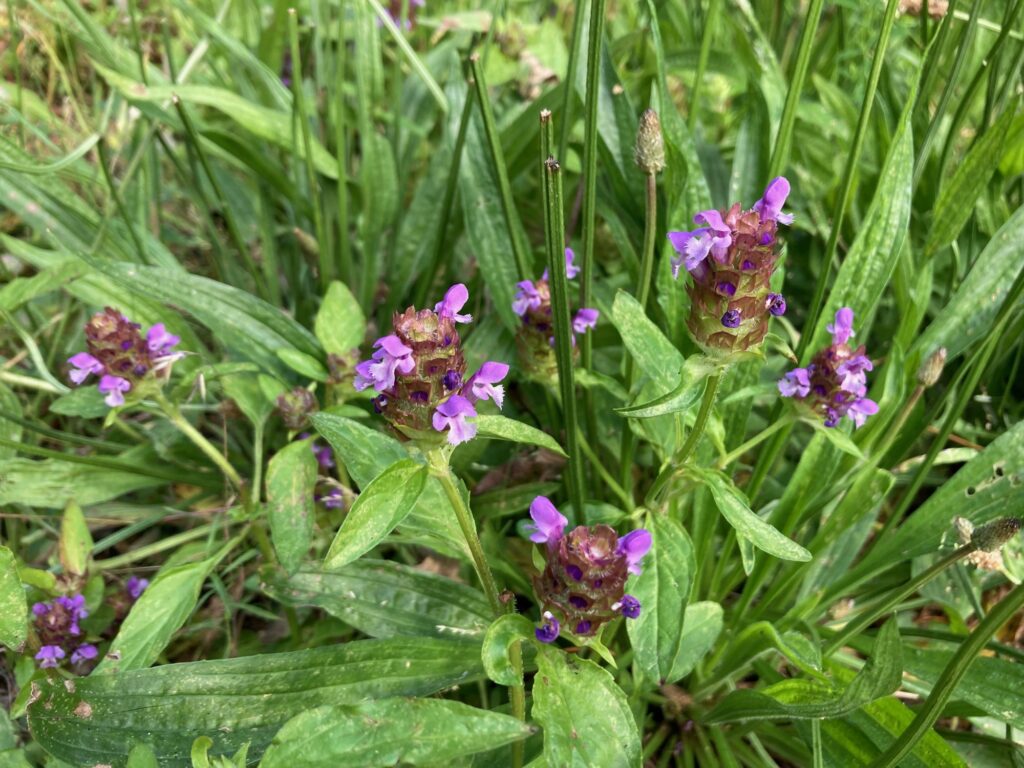
There is a plant that grows where feet fall, and mends. It keeps low in the lawn and along the trodden edges, no taller than a hand, and where a hurried walker sees only grass it lifts a small blunt club of a flower — stacked like a little green cone, opening to two-lipped blooms of blue and violet. The old people did not have to be told what it was for. They read it in its shape and carried it to every hurt the working day could make. It is the herb that heals, and it asks for nothing but the grass it already has.
Where it grows, and how it shows up here
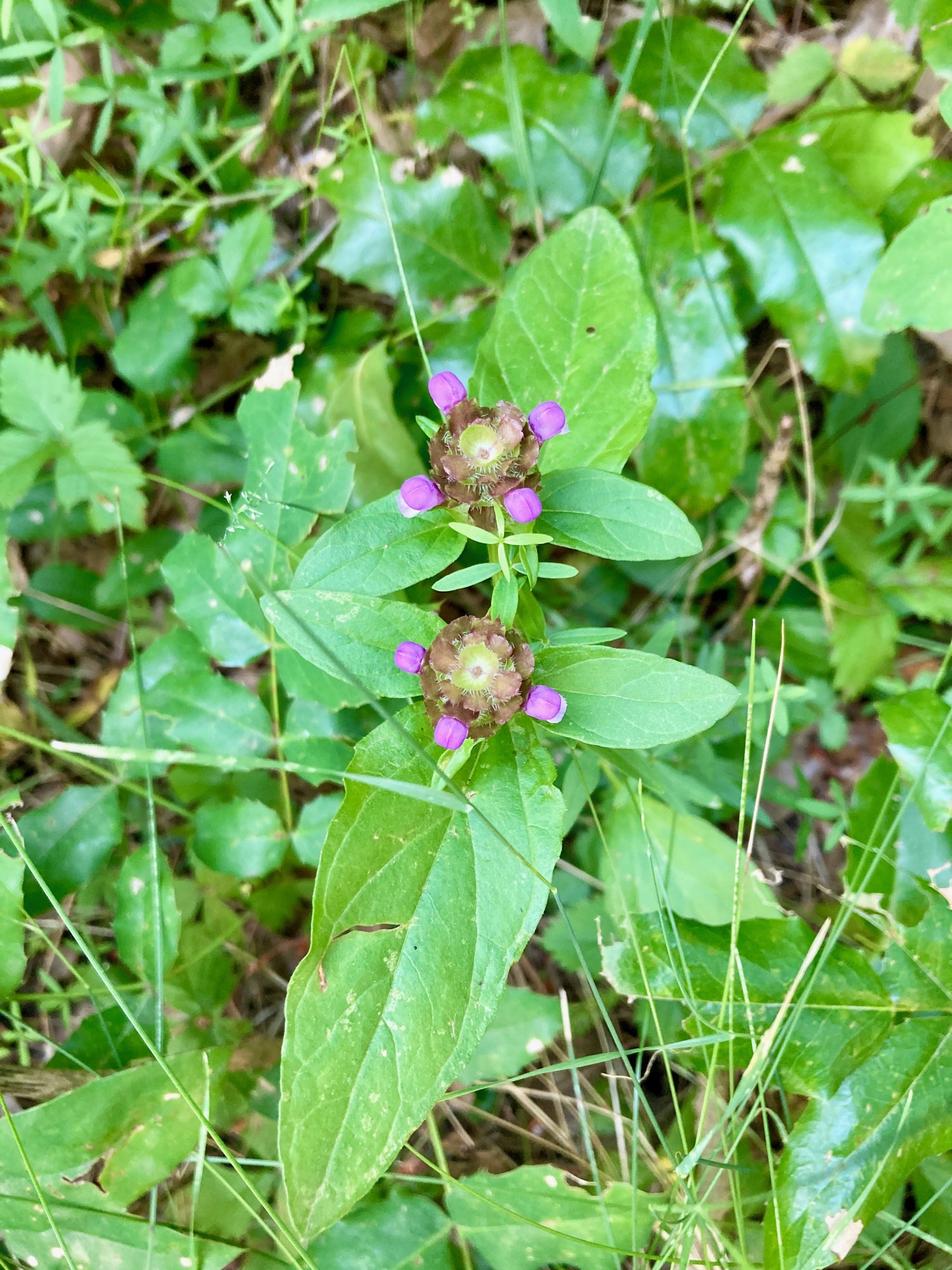
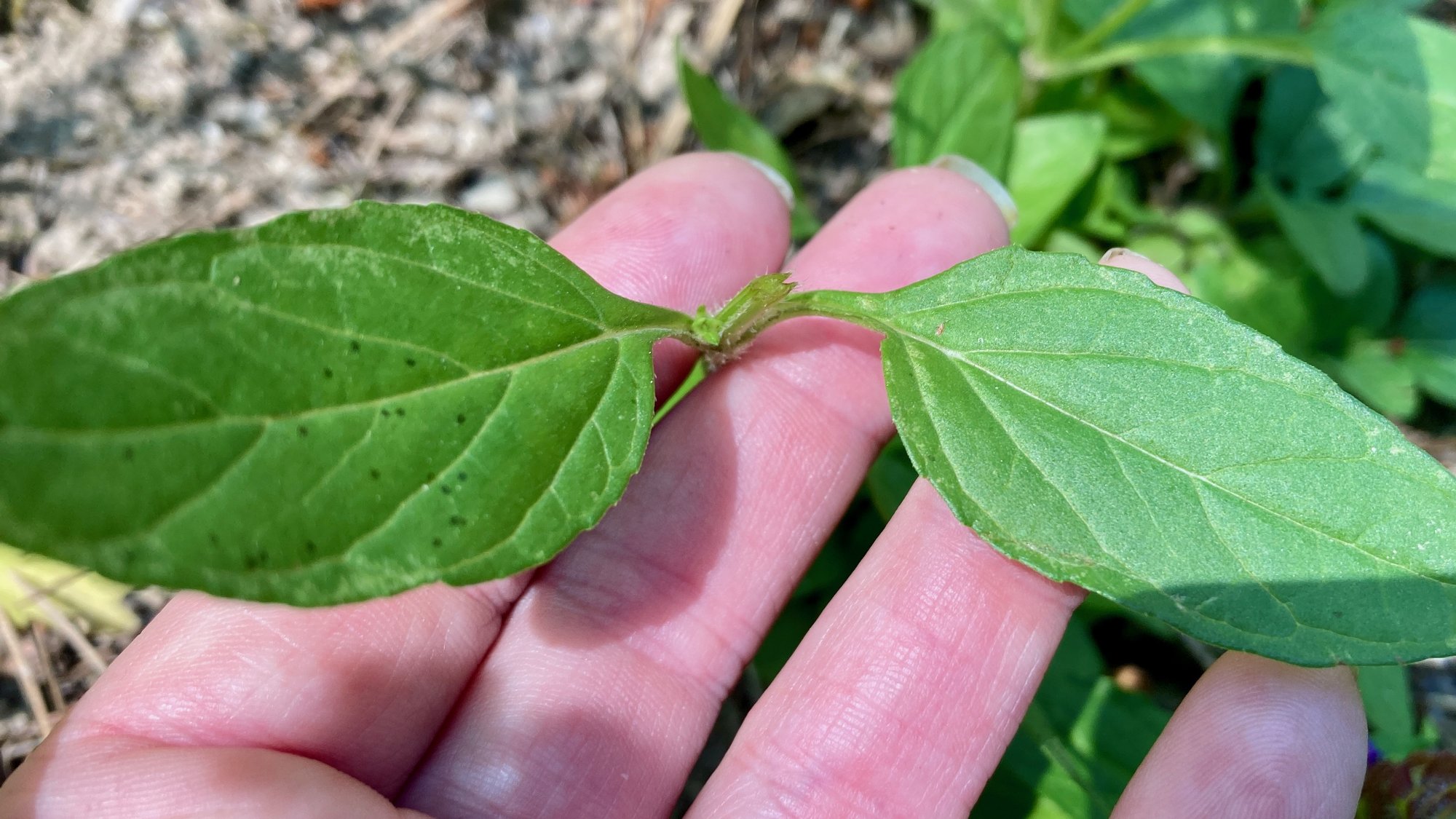
Prunella vulgaris — the common one, the everywhere one, its second name a small joke on how easily so useful a plant is overlooked. It is a mint, and it holds the family’s marks: a squarish stem, often flushed red, and leaves in facing pairs down its length. But it forgot to be fragrant — crush it and almost nothing rises — and it wears its flowers strangely, not in loose whorls but gathered into that dense terminal club, a spike of overlapping hairy bracts from which the hooded flowers open a few at a time. Look close and the upper lip of each bloom curves over like a little billhook; look closer and you will find a single pair of leaves set right at the foot of the flower-head, as if the plant kept two hands cupped beneath what it offers.
Its names are a catalogue of its office: self-heal and heal-all and all-heal, woundwort, carpenter’s herb, hook-heal and sicklewort, brownwort, blue curls, and — from the settlers who carried it across the sea — Heart of the Earth.
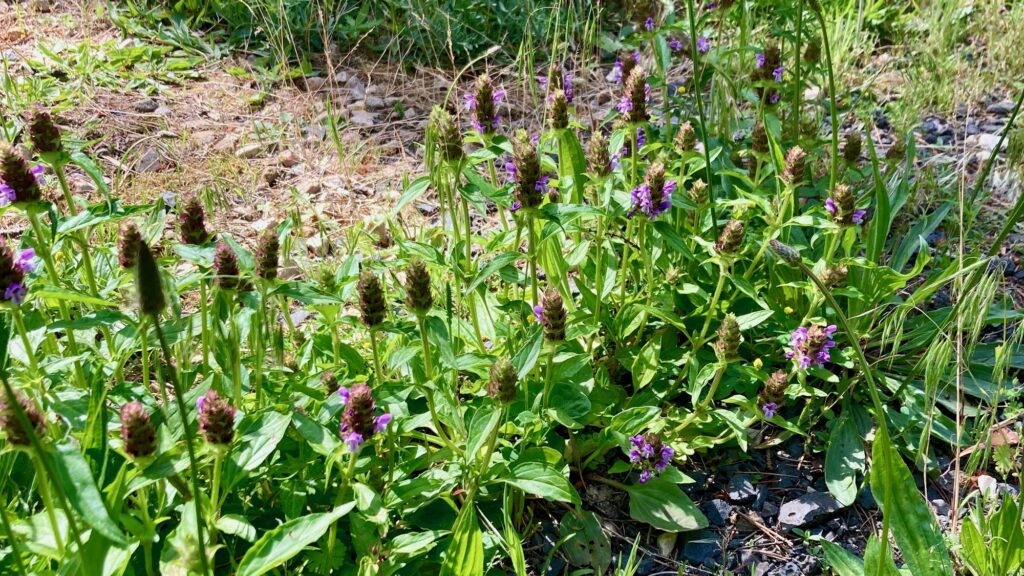
Here it belongs to the grass and the edges. It runs low and crowds the gravelled margins and the pathsides, and comes up wherever the ground is open and a little disturbed and the sun can reach it — among the ribwort and the wild strawberry, at the foot of the pavers, in the broken sun rather than the deep forest dark. And it keeps one habit its restless mint cousins do not: it does not travel. It sends out no running roots to seize new ground; it holds its patch and thickens it, and if the grass is cut it only blooms the shorter. There is a great deal of it, and it stays where it is.
When it comes
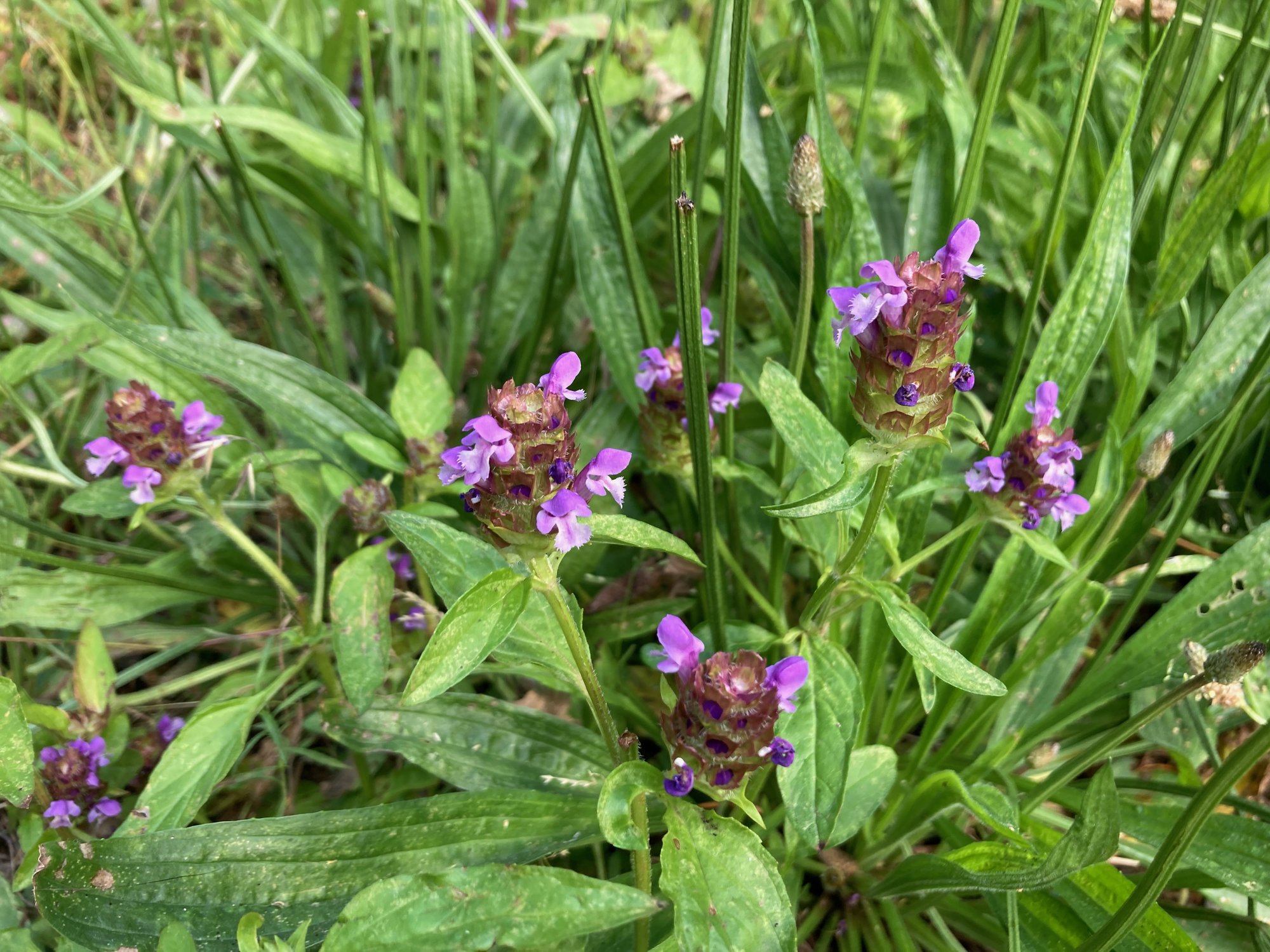
Self-heal is a patient plant, and a long one. It greens up early and low, and the blue-violet comes on through June and holds clear across high summer into the first weeks of July here and well beyond — not the three-week fire of its neighbor St. John’s Wort, but a slow, steady blooming that keeps the grass in flower for months. Cut it and it flowers lower; leave it and it flowers on. It is one of the long menders of the summer lawn, always a little more of it coming, so there is no racing this one and no missing it.
The lore
Its Latin is a soldier’s word. In the crowded German garrisons of the old wars a foul sickness went through the camps — die Bräune, the browning, that furred the tongue and closed the throat — and the herb the camp physicians reached for took the sickness’s name: Brunella, which later hands smoothed to Prunella. So the flower’s name is not a flower-word at all but the memory of a camp fever and the plant trusted to meet it.
The old reading went by likeness. Held to a glass, the little hooded bloom can be seen two ways — a throat with its glands swollen, or the curved blade of a billhook — and the plant was read for both. The first likeness made it a herb of the mouth and throat; the second made it the wound-herb of everyone who worked with an edge, the carpenter and the reaper and the laborer, for the tools that fed a household were the tools that cut it. Here, they held, was the plant that joined a wound together and made it whole and sound, inward and outward alike. Hurt yourself, the old herbals promised, and with this you may heal yourself — and that promise, plainly, is its English name. When it followed the settlers into new dooryards and greened up as though it had always been there, they gave it another: Heart of the Earth.
Venus, and the quiet mending
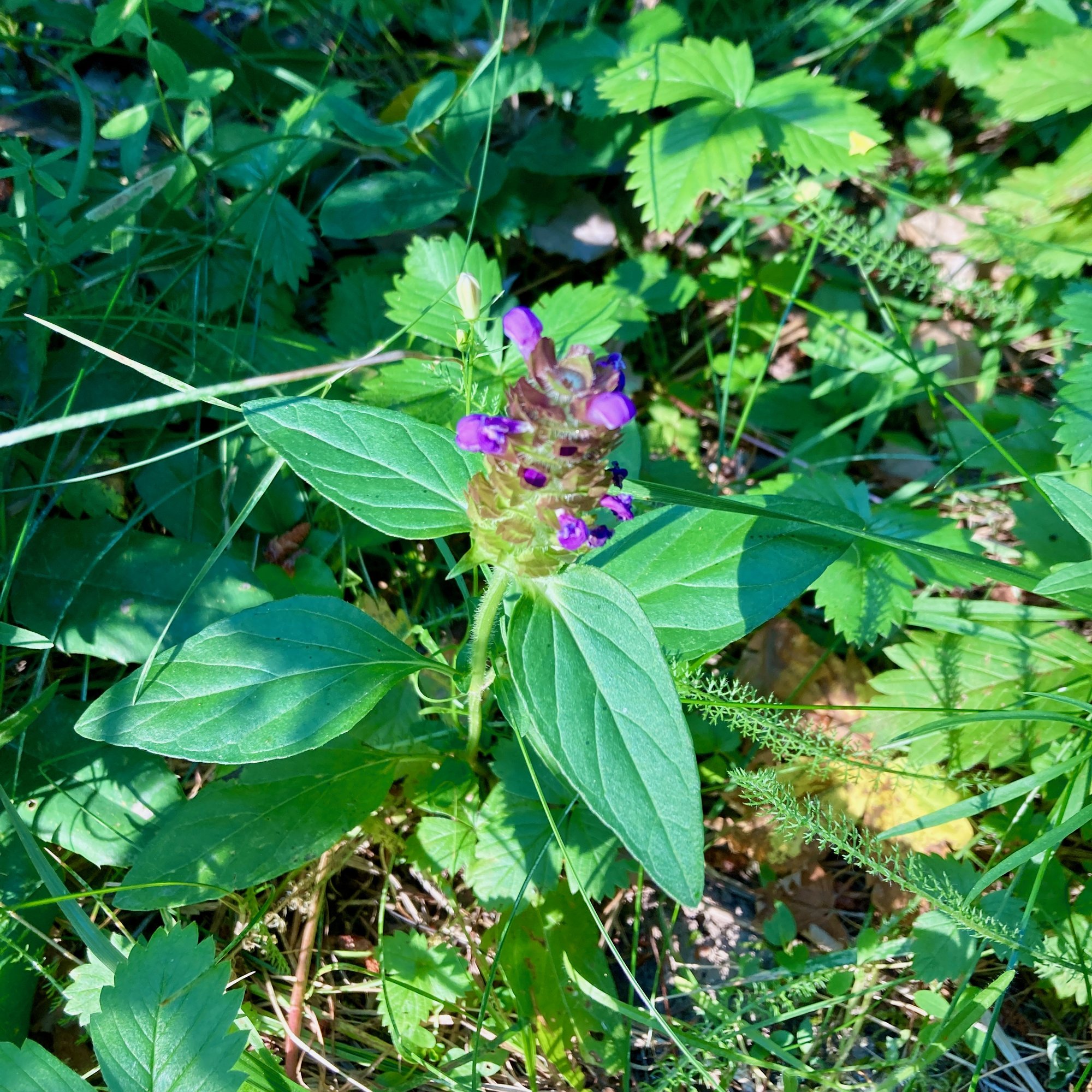
Self-heal answers to Venus — but not the Venus of the rose and the love-charm. Its is the quiet Venus, the one who keeps the house and mends what is hurt, read less from any loud old rulership than from a plain fact: peoples who never met one another all reached for this same low plant to close a wound. And it is a herb of the earth it hugs — Heart of the Earth, grounded and contained, the healer that stays where it is set.
Its first office is healing, and it is the all-heal of the working: added to any charm or bundle for mending, and (it was said) a giver of heart to those worn down and half-hopeless of being well again — courage for the long convalescence, not the swift cure.
Past the mending it keeps a quiet guard. Folk held that a witch might grow self-heal in her garden to cover her workings — a plant so ordinary, so lawn-common, that no eye lingered on what grew among it — and it went into the purifying wash for a floor or a threshold, to clean a room of more than dust. This is the peaceable, home-keeping face of Venus: not the ward that drives evil off, as St. John’s Wort does with its fire, but the quiet that settles a house.
And it was trusted with the hurts that draw no blood. There is a thread of old practice that a bite or a wound taken in a dream should be tended waking, with self-heal, because a hurt met in the dark is a real hurt and wants mending too — the plant called on to bring the spirit back to the body. Some held that the old gatherers took it at the new moon as the Dog Star rose — near the time it flowers — to mend the illnesses that have no ordinary cause, the fairy-struck and the elf-shot; and its hotter root was given to hunter’s magic, to clear the sight before the hunt. To the runes it was given Ingwuz, the seed kept safe in the dark; among the cards, Judgment — the thing made whole and called back up.
Its nature and virtue
Self-heal is the gentlest of the menders, and the least showy. It carries no scent worth the name, a mint that forgot to be minty; no fire, no poison, no edge. Its leaves and flowers are food as much as anything, mild enough to eat straight from the path. And alone among its restless kin it will not run — it makes no traveling roots, takes no ground that is not offered, keeps to the patch it holds. A healer with no wish to overrun.
Its virtue is wholeness. It closes what is open and joins what is parted, and the old reading did not stop at the skin: the herb trusted with the outward wound was trusted with the inward one too — the grief, the despair, the worn-down heart, the hurts that do not show. It is the plant of the working hands and the long road, the carpenter’s and the reaper’s and the traveller’s, and it keeps the good company of the other menders of the grass — plantain at the pathside, yarrow in the meadow. Whatever caution a blend may carry belongs to its sharper companions; self-heal itself asks for none. It is simply, plainly, the herb that heals.
In the stillroom
Self-heal doesn’t make me hurry. St. John’s Wort is a race against the solstice, but this one is patient — it comes into the grass in June and holds through the summer, and if I miss a week there is always more coming. So I gather it easy, on my knees in the lawn and along the gravel edges, taking the flowering tops and the good leaves, never more than a third of any patch, and always a picture of it in bloom before I take a thing.
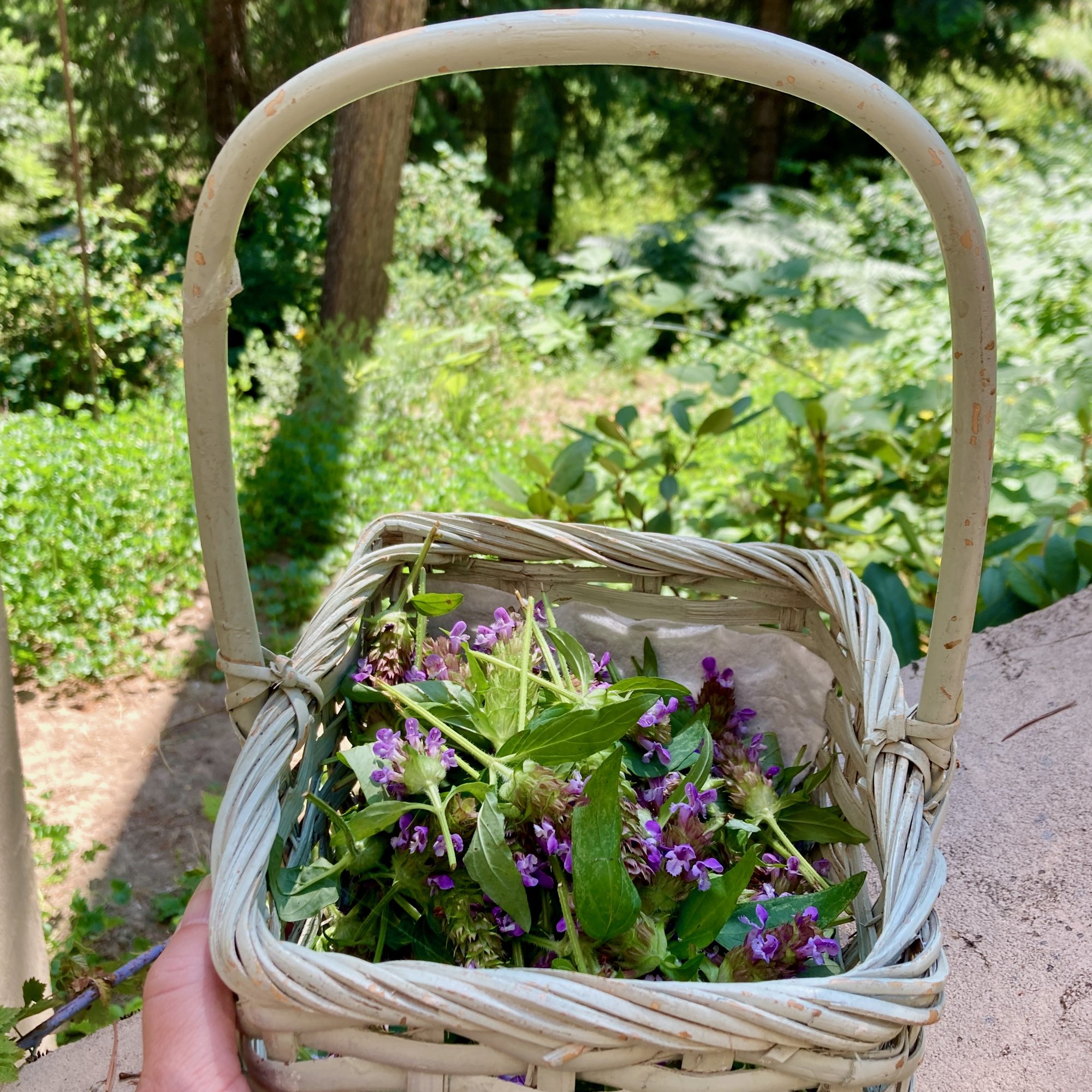
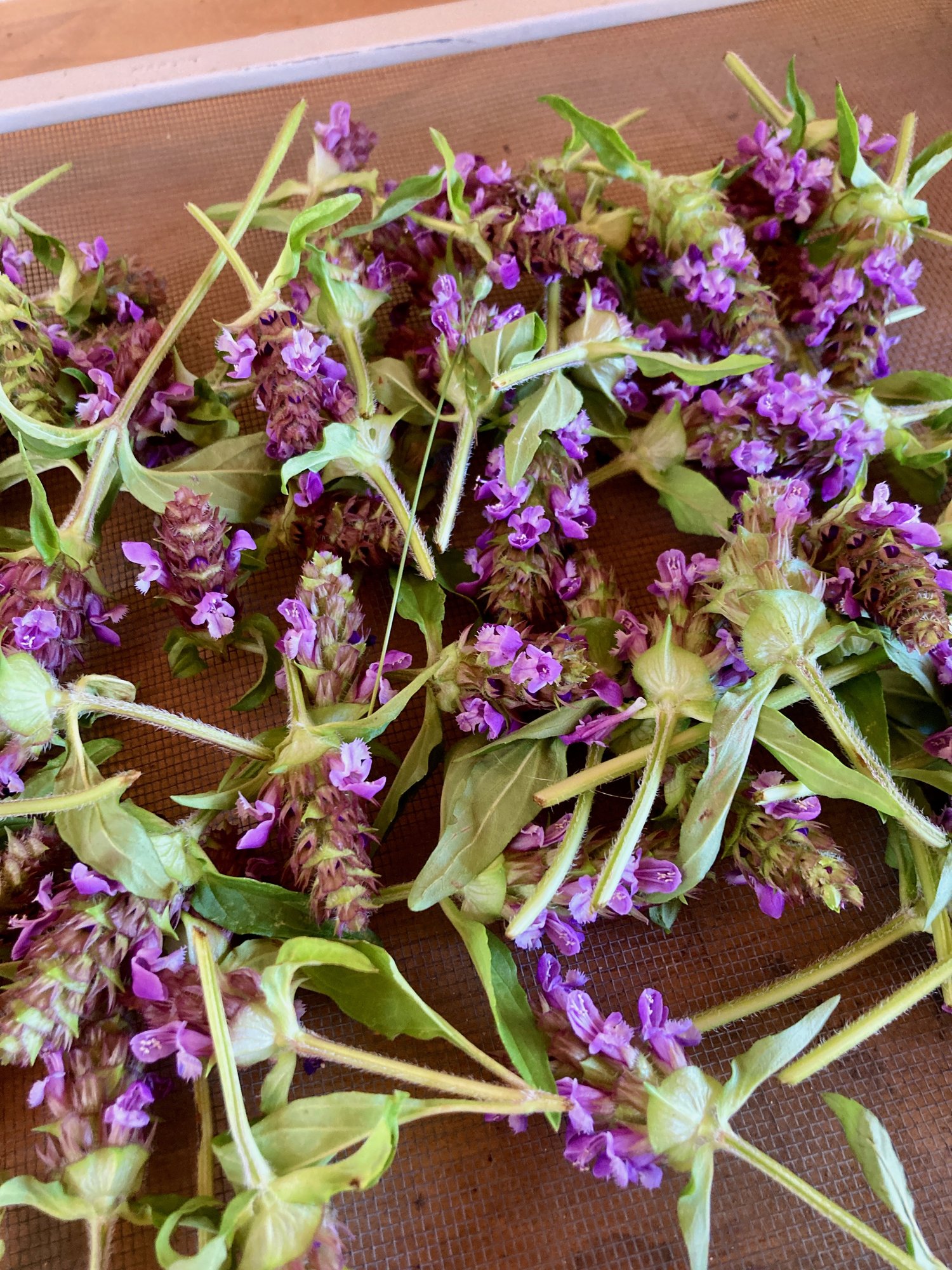
Then it waits, the way it likes to. The tops and leaves go into jojoba — a light, long-keeping oil that suits a plant this gentle — and steep slow and cool until the oil takes the green of them. No sun-watching, no clock: just time, which self-heal has always had plenty of.
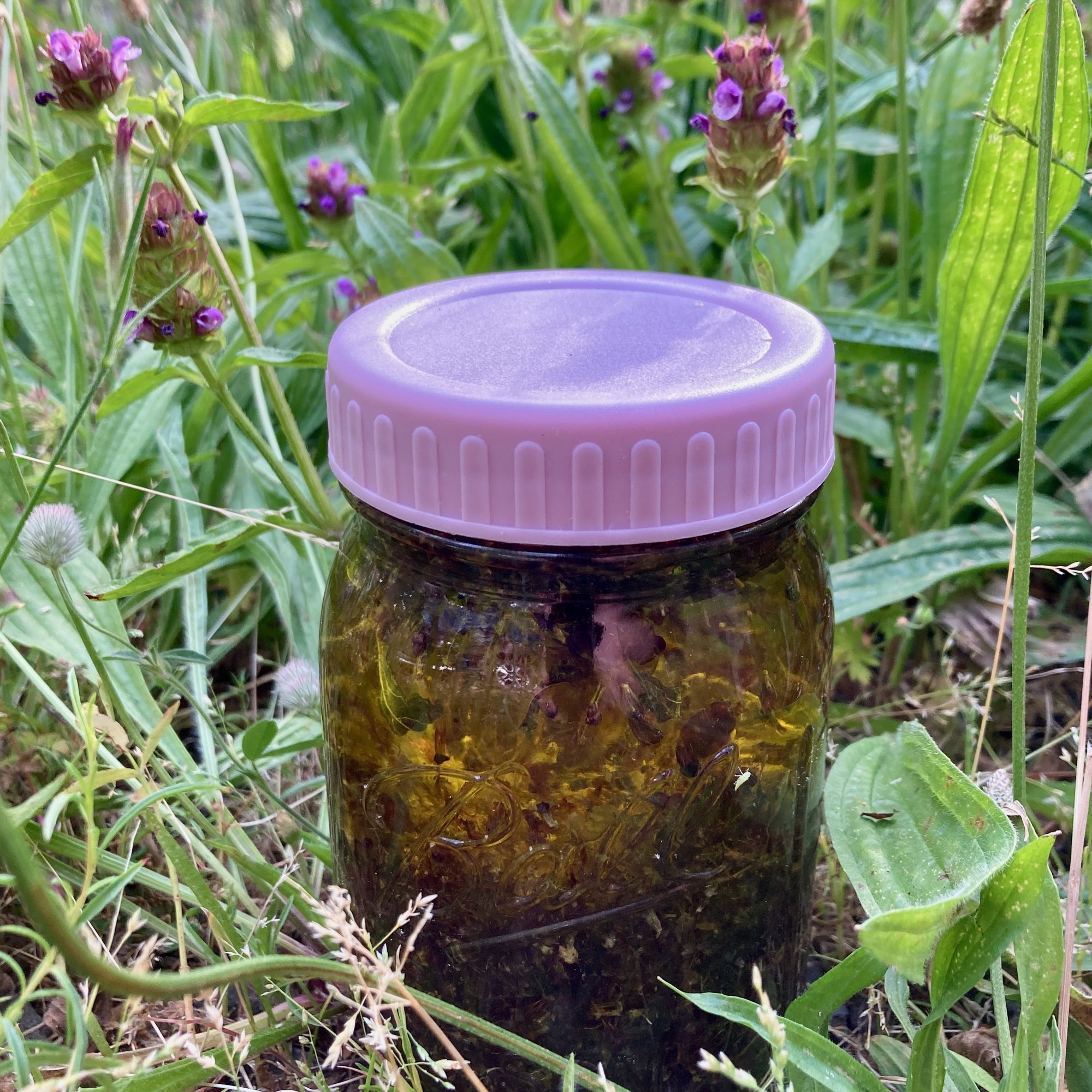
That quiet green oil becomes the Self-Heal Lip Balm — the plant’s own infused jojoba with castor, a little shea, and beeswax, and nothing sharp added to it, because it is made for the thinnest skin there is: the mender’s own oil, in a form you can carry in a pocket and reach for without thinking. And it lends its quiet to the Bite Balm, too, folded in beside plantain, yarrow, and wild chamomile — the small tin the family keeps for the after of a summer afternoon spent outdoors.