Saint John’s fire
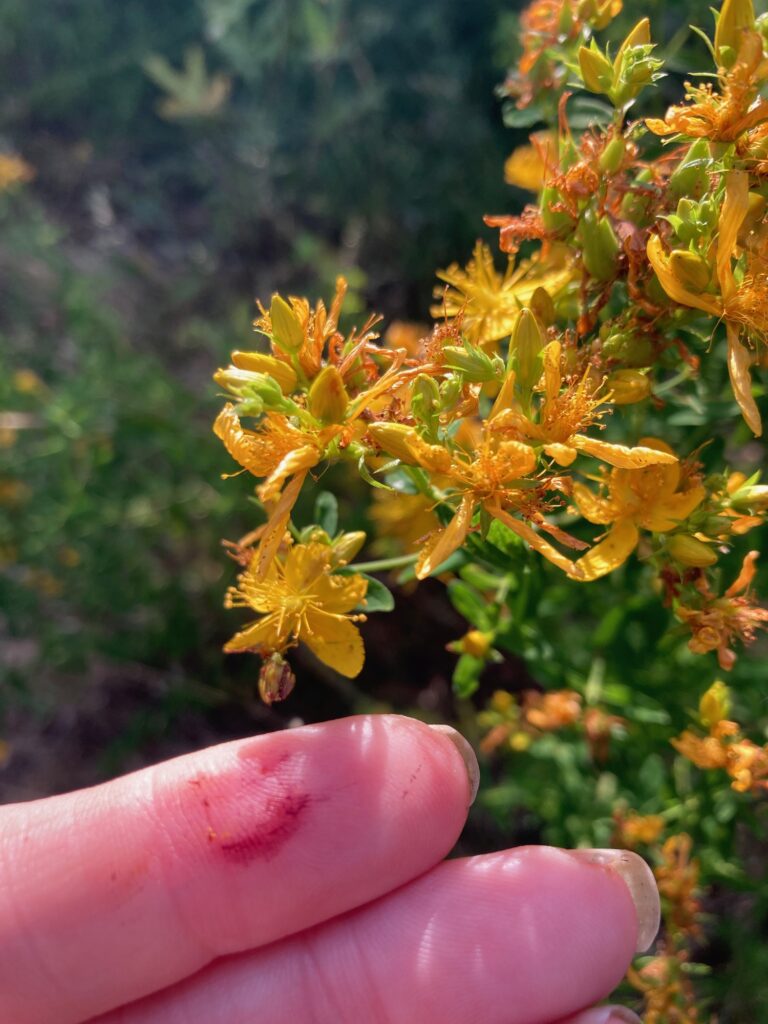
There is a plant that saves its brightest gold for the longest days. It comes up in the open ground where the light falls hardest, and by the solstice it is a thousand small suns on wiry stems, each flower a burst of yellow rays around a center crowded with stamens. Crush one of its buds between two fingers and it bleeds — a red-purple juice, startling from so yellow a flower, that stains the skin and does not quickly wash away. The people who knew it longest called that stain a saint’s blood, and gathered the plant on the one night of the year they trusted above all others.
Where it grows, and how it shows up here
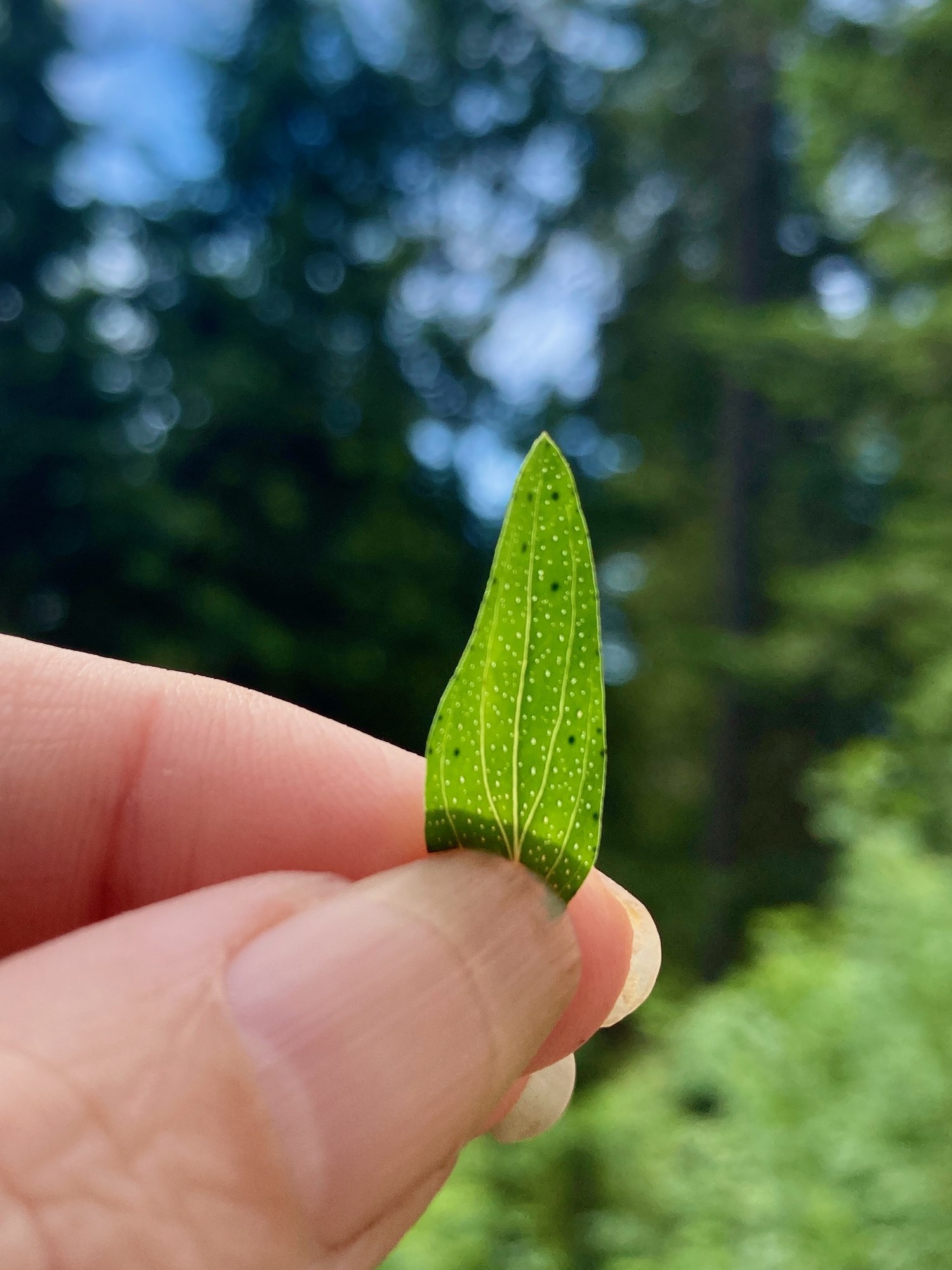
Hypericum perforatum — the pierced one. Hold a leaf up to the sun and you will see why: it is stippled all through with tiny translucent points, hundreds of them, as though a needle had been at it. They are oil glands, and the old story said the Devil himself pricked the leaves in spite, having found the plant proof against him. The flowers give the surer sign still — five bright petals, often edged and flecked with small black dots, and at their heart a great spray of stamens that makes each bloom look half-open and half-burst. The stems run reddish and stand in many branches; the leaves sit in facing pairs, narrow and stalkless. Rub the flowers and the red rises.
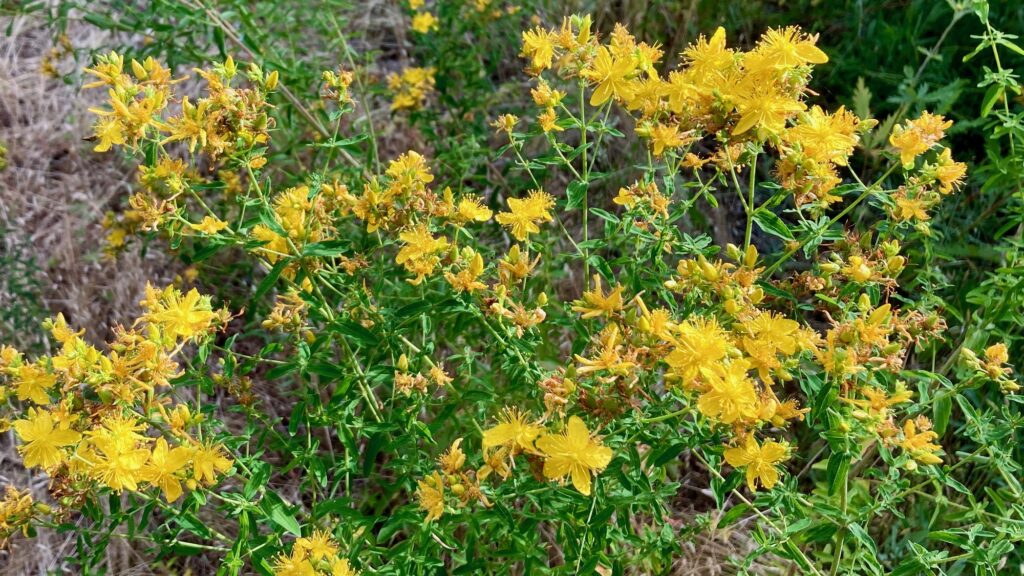
Here it keeps to the sunlit edges — the open, well-drained ground where the tree-shade thins: along the fence lines and the bright margins, in the broken sun rather than the deep forest. It stands waist-high and higher where it is happy, and it is happy in a great deal of the open ground, coming up in strong branching stands that carry hundreds of flowers at their peak. It is a plant that follows the light and the disturbed edge, and it has made itself thoroughly at home on the bright bones of the grounds.
When it comes
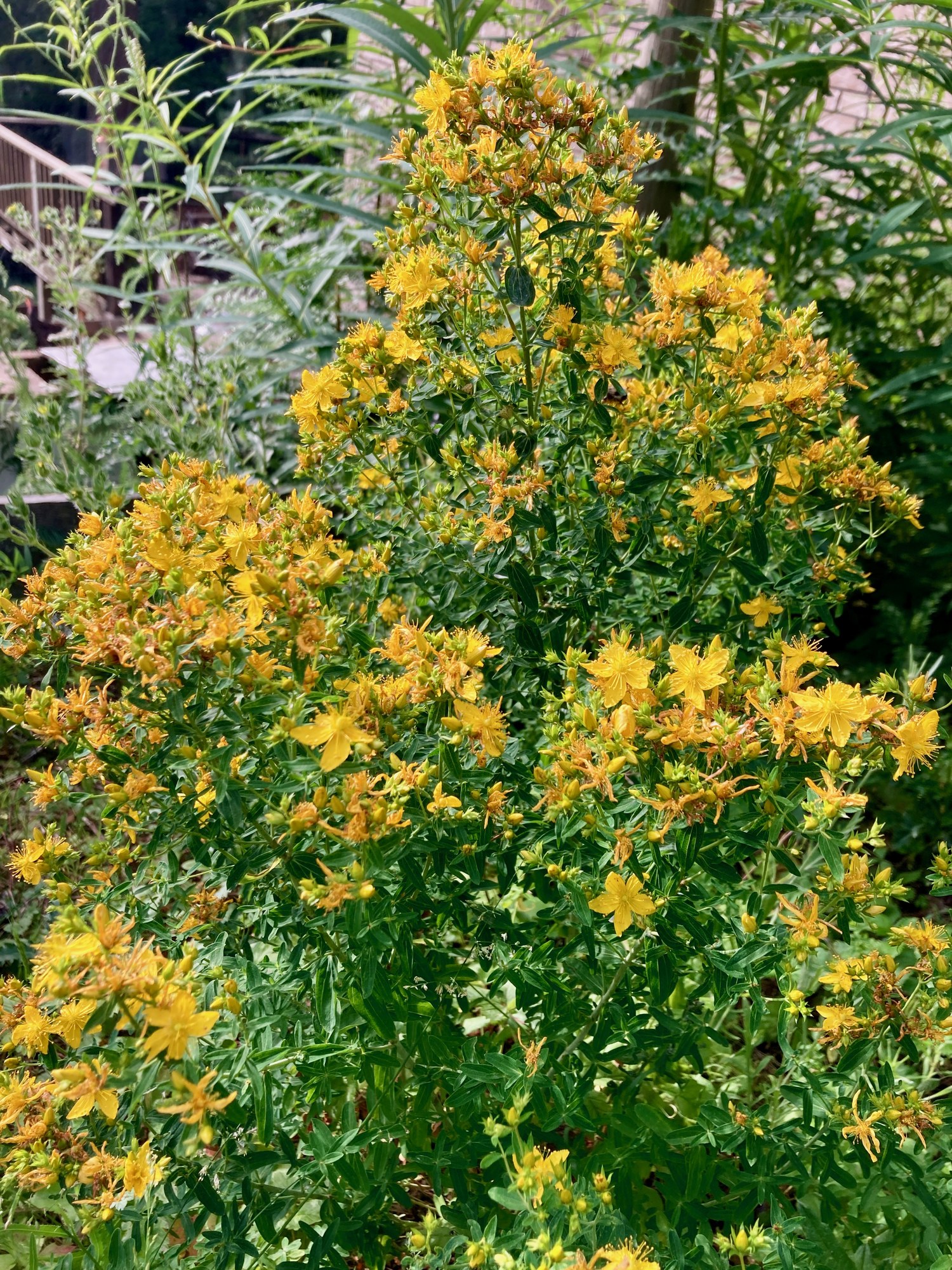
St. John’s Wort belongs to high summer, and to the sun at its strongest. The buds swell through June, and the gold comes on around the solstice and holds through the first weeks of July — a bloom timed, as if by old agreement, to the longest light of the year. The window is not long, but the forest widens it a little on its own: the stands in the full sun come first, and the shadier stands under the trees come later, so the gold moves across the grounds for a few weeks rather than all at once. Within that span the highest flowers of any stand begin to pass, the spent blooms rusting to a burnt orange while fresh gold still opens below them, and then that stand turns to seed and the fire goes out of it for another year. It is gathered at the one moment it is fully itself: in flower, in full sun, after the morning’s dew has burned off. Miss the window and it is next year’s plant. The forest keeps St. John’s calendar, and St. John’s calendar is the sun’s.
The lore
No plant in the old European reckoning stood more squarely against the dark than this one. Its very names are a charm against evil: fuga daemonum, the demon’s flight; the devil’s scourge; in Scotland the Deil-chaser. Its garden-name, Hypericum, was read as hyper eikon — “above the image” — for the sprigs hung above a doorway or a holy picture to keep harm from crossing under.
Its day is Midsummer, and its saint is John. Gathered on St. John’s Eve or the morning of his feast, the flowering tops were hung at windows and over lintels to turn away lightning, fire, storm, and every kind of ill-wishing; cast into the Midsummer bonfires, they drove off what the year had gathered of the unwelcome. Brought into the house on that one day, they were held to guard the whole household against misfortune until the light came round again. Stepped on carelessly, the old tale warned, and a faerie horse might rise beneath you and carry you off into the dark.
And it was a plant of seeing as much as shielding. Sprigs slipped under a pillow on St. John’s Eve were said to bring a true dream — of a future love, or of whether the sleeper would see another year. A wilting sprig hung over a bed foretold ill; a fresh one, life. Where the plant grew, the tradition held, no evil thing could keep its footing.
Sun, fire, and the saint’s blood
St. John’s Wort answers to the Sun and to the element of Fire, and no correspondence was ever plainer: a solstice flower the color of caught daylight, blooming to the exact turn of the sun’s high year. It is the sun’s own plant — sol terrestris, the earth-bound sun — and everything it does in the working runs back to that light.
Its first office is protection, of the driving-back kind. Where arnica raises a living wall, St. John’s Wort repels — it is carried, worn, and hung to turn evil away at the threshold, the classic ward against spirits, storm, and the evil eye. Burned, its smoke cleanses and banishes; hung green at the window or door, it guards the house; worn on the body, it is the old amulet against harm on the road and harm in the night. It keeps the good company of the other Midsummer guardians — vervain, mugwort, yarrow — and gathers strength among them.
Past the ward, the sun’s virtues follow: strength, courage, and vitality, the bright resilience of a plant that will not be shaded out; happiness and light, for it was reached for against the low, dark moods as surely as against dark spirits — the plant that lets the sun back into a shuttered room. And it is a plant of prophecy and sight: the solstice dream-herb, laid under the pillow on its own night to open a true dream. In the working it is met as the flowering tops — fresh for the red solar oil, dried for the protective sachet, the banishing incense, the amulet, the wreath hung at the door. Its signature above all is that stain: the red that rises from the yellow flower, the sun’s fire made visible, called for centuries the blood of the saint.
Its nature and virtue
St. John’s Wort is a plant of light against darkness, in every register the old world used the word. Held to the sun, its leaves are full of small windows; crushed, its flowers give up a hidden red; hung in the house, it turns away the storm. Its whole character is that of a thing that carries light into dark places and does not let the dark settle — the lifted mood, the guarded threshold, the true dream in the black of the shortest night. It is generous with its gold and unguarded in its blooming, a plant with nothing shadowed about it.
It keeps one plain boundary, and it is a boundary of the sun: the same fire that fills it can, in strong summer light, make skin that has met it quick to burn. It is a light-bearer through and through — worn, carried, burned, and infused; taken in only with the sun kept in mind. Its affinities are the solstice and the bonfire, the color gold and the saint’s-blood red, the open sunlit ground and the turning of midsummer, the threshold and the true dream. Its companions are the other guardians of the longest day.
In the stillroom
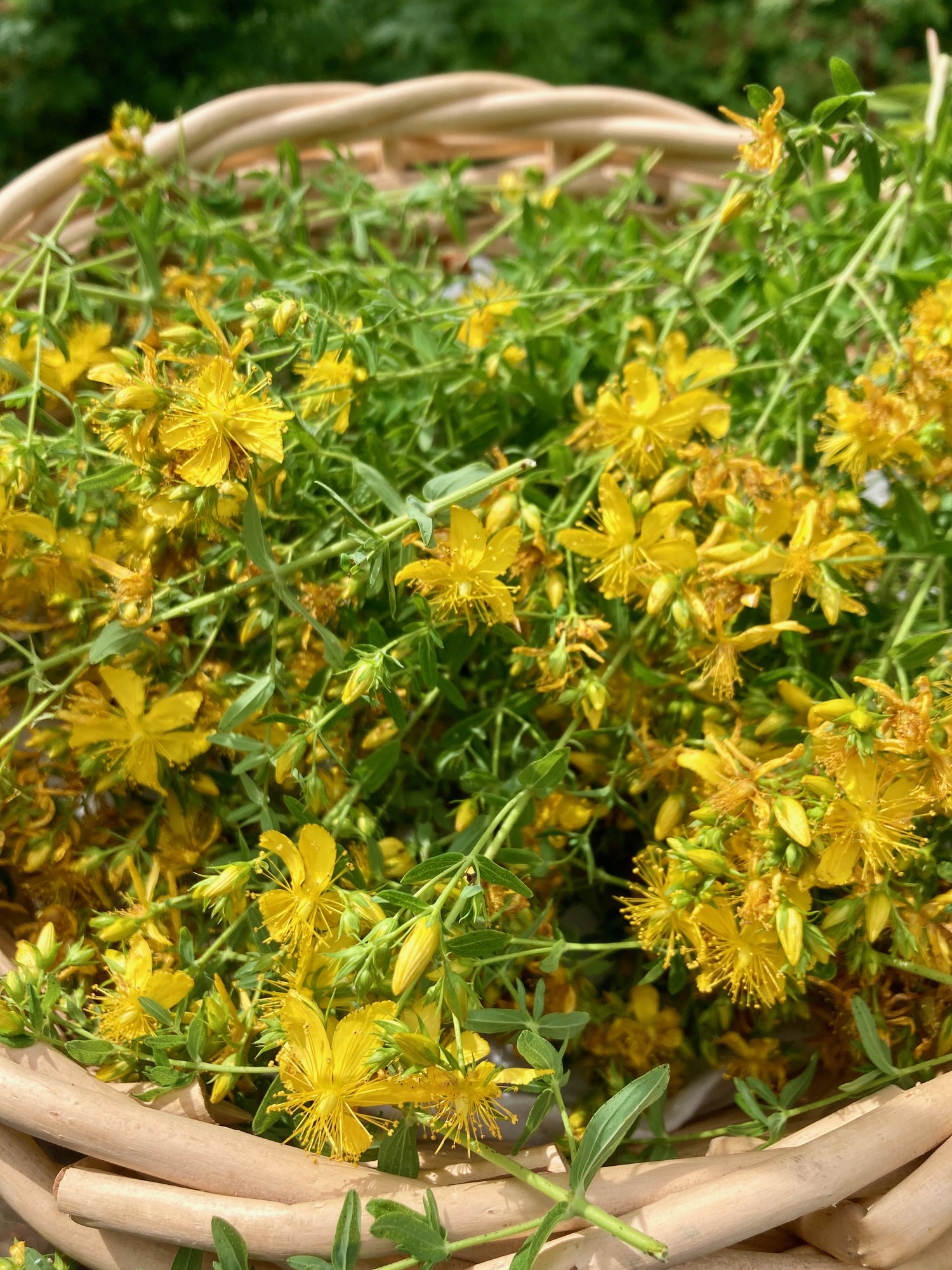
St. John’s Wort is a race against the sun. The window is short here — the gold comes on around the solstice and starts to go over within a few weeks — so I watch the stand and go out on a bright morning once the dew has dried, and take only the flowering tops, the buds and open flowers where the strength is. I test them the old way, with a squeeze: if the bud bleeds red-purple on my fingers, it’s ready, and my hands come home stained for the rest of the day. Flowers only, never more than a third of any stand, and a picture of it in full bloom before I take a thing.
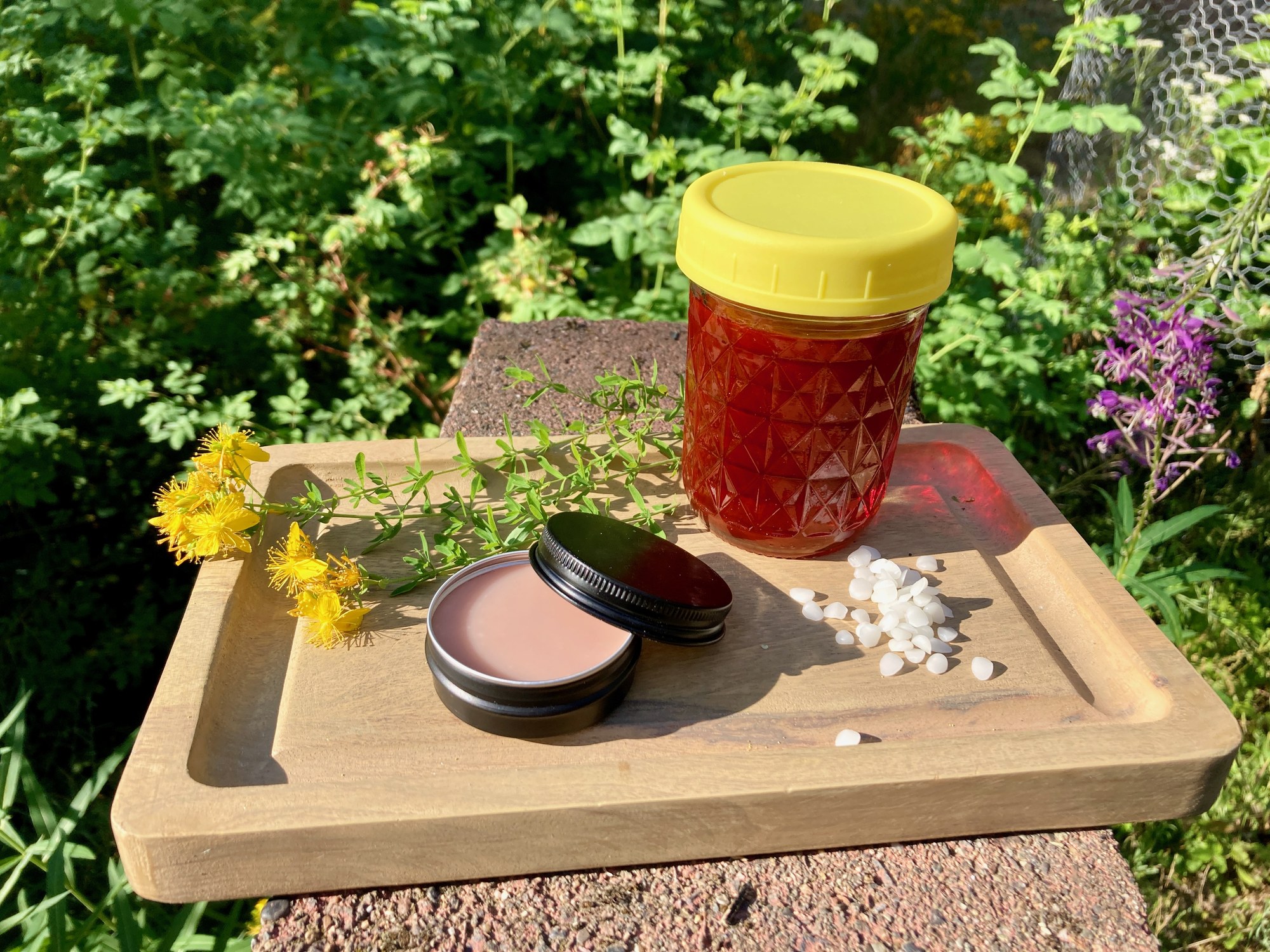
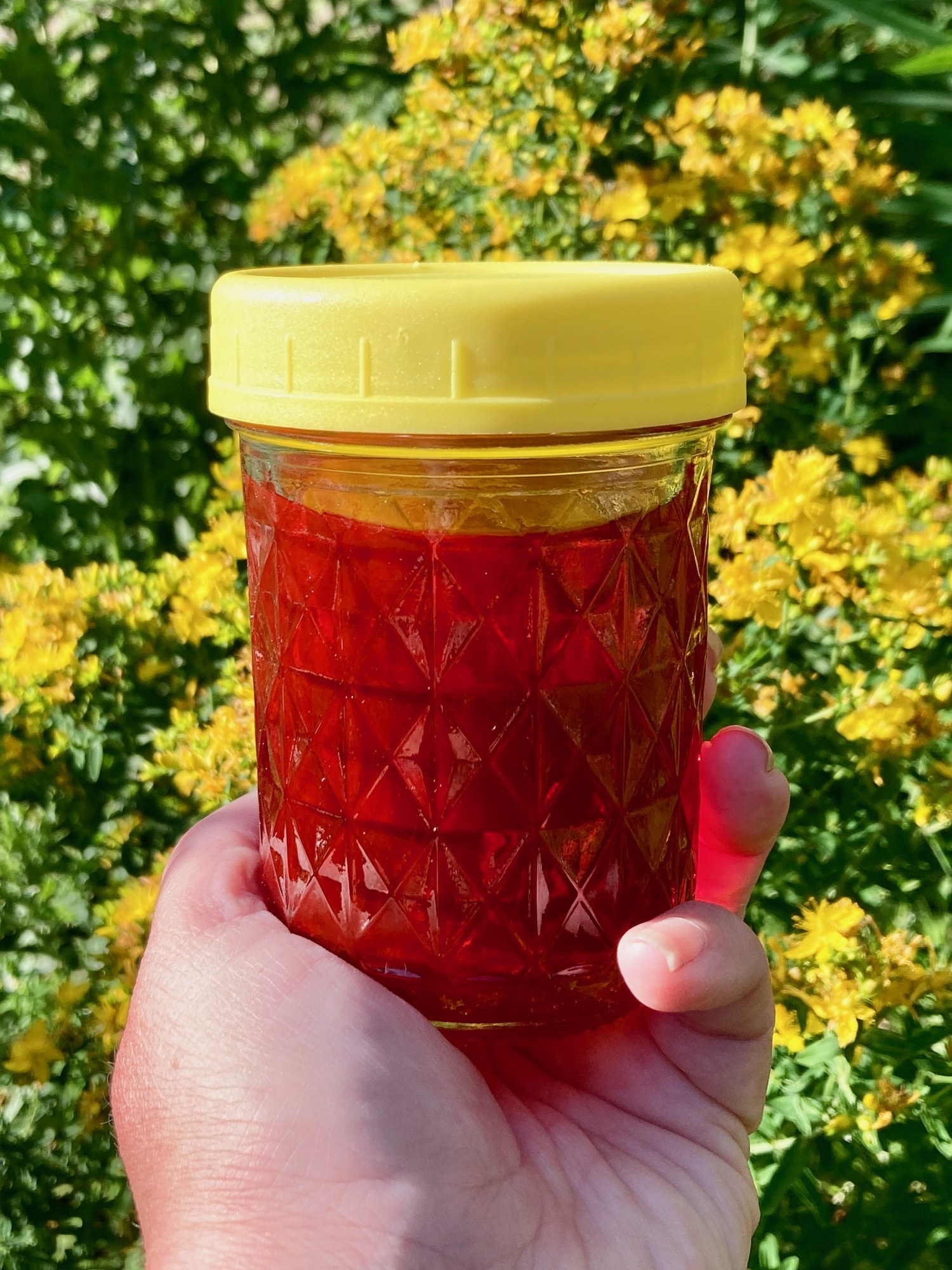
The fresh tops go straight into good olive oil the same day — fresh only, never dried; dried St. John’s Wort makes a pale, tired oil, and this plant is worth catching at its moment. Then it sits in the sun and steeps, and over the days the oil turns — from green-gold to amber to, at last, the deep blood-red that tells you the flower gave everything it had. That red oil is the whole point. It becomes the St. John’s Wort Salve — the oil and organic beeswax, nothing else, poured while the color is still true. The red is the flower’s, and the proof of a fresh-caught harvest.